The Point of the Jesus Lizard

Once in a while you see an example of rock music that makes you realize exactly what that well-worn exercise is all about. The Jesus Lizard and David Yow were to me always the supreme exemplars of rock music: a tension between precise, simple musicality and raw unhingedness; the Apollonian and the Dionysian. On the occasion of the Jesus Lizard’s brief reunion a few years ago, Sasha Frere-Jones wrote in the New Yorker that Yow “acts like a storyteller who has just arrived, out of breath and perhaps drunk, with the need to tell us something unsettling.” I would go further and say that Yow seems like he has witnessed the end and that by the time we hear his apocalyptic message there will be no more anything, or as a friend of mine who knows rock’s tensions well once put it, “it seemed to me that part of the point of The Jesus Lizard was that in the future there would no longer be magazines like the New Yorker.”

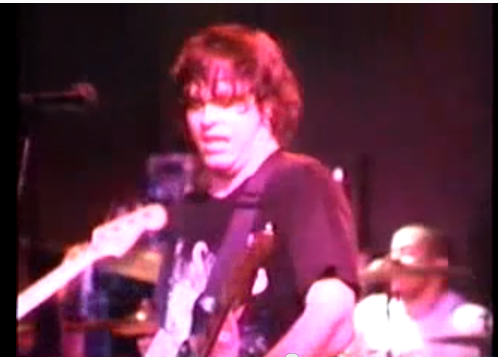
Being there is still the best way to experience rock but this finely-made video captures the tension quite well.  The drummer and bassist pound out a syncopated rhythm; the guitarist’s hollow-body wails. The instruments are festooned with weird little totems, the singer sticks his hands in his mouth. Snippets of grim lyrics reach us through the noise: “the neighbor’s house was burning/but now is only smoking.” The singer contorts his face; he is possessed, a yowling messenger made mad by the unsettling thing he has been dispatched to tell us about. And just as it reaches a perfect pitch-point of psychic horror, it promptly resolves into four self-amused guys standing in a little room — the essence of rock music, as anyone who has been there knows.

48 Hours of Eating in the Fragrant Harbor

All prices in USD, not HKD. 

We went to Hong Kong for a variety of reasons but near the top of the list was to eat. What we learned quickly is that food in Hong Kong is really expensive. But it’s good. Not only non-toxic (a serious concern in China that dampens my usual try-everything ethos) but often all-organic.

For a late Saturday lunch, we ventured to Linguini Fini, an Italo-American place in a mall of restaurants. Not a food court, but a high rise wherein each floor was a different restaurant.  The elevator opened directly into the lobby. Decor nice, food generally decent. Excellent burger. A bit small, but with smashed garlic and homemade ketchup and bright nice tomatoes and lettuce. You don’t see that in China — if so, be scared. But it was $23. S– got some ok pasta that was advertised as served with a veal, pig head and tripe ragu’ but it wasn’t that meaty. Pasta overcooked. $26. Bottle of Rogue beer? $12. Espresso? $7 each. Good espresso, though. Bit of a ripoff, but I have to remind S– and myself that this is still Asia and so such food may be exotic and pricey here. Plus Hong Kong seems loaded with British bankers making loads of pounds sterling. Total: $89.

Dinner was better. After braving the hour and a half wait for a funicular car and taking in the stunning views on Victoria Peak, we found Cafe Deco, a spacious place with a stellar view of Hong Kong. Very international menu, the type that usually inspires suspicion (pizza! kebabs! pasta! steak!) menu but they pulled it off. A huge multi-ethnic party of mainly men, led by an enormous mangione, seemed to be determined to test every different type of cuisine, and weren’t beyond giving the staff impromptu lessons as to how food should be prepared or served. We were more modest and split a 14 oz. New Zealand steak, a glass of Mondavi, an excellent salad with grilled parmigiano, asparagus and zucchini. Fresh baked-to-order baguette. For dessert, a fruit platter of fresh, real, non-toxic fruit. A little more than lunch at $92.

After seeing the vaunted (and twenty-year-old — most of my record collection is older than this guy) Tian Tan Buddha, we found ourselves stuck in Ngong Ping, a tasteful tourist village on Lantau Island. Opting to go local finally, we settled on Cantonese lunch at Pak Loh Garden, a large and fairly unremarkable place. Food was plain but decent: two kinds of pork dumplings off the dim sum menu, a huge bowl of veggies, mushrooms and noodles, and some grilled pork with mustard. Tea for two and they had the gall to charge $2 for some pre-meal peanuts. Total: 44 bucks. Thus better to get Cantonese in the real Canton, and no, I don’t believe the old Hong Kong saw that all the good Cantonese chefs fled the mainland for Hong Kong in 1949.

img_1537
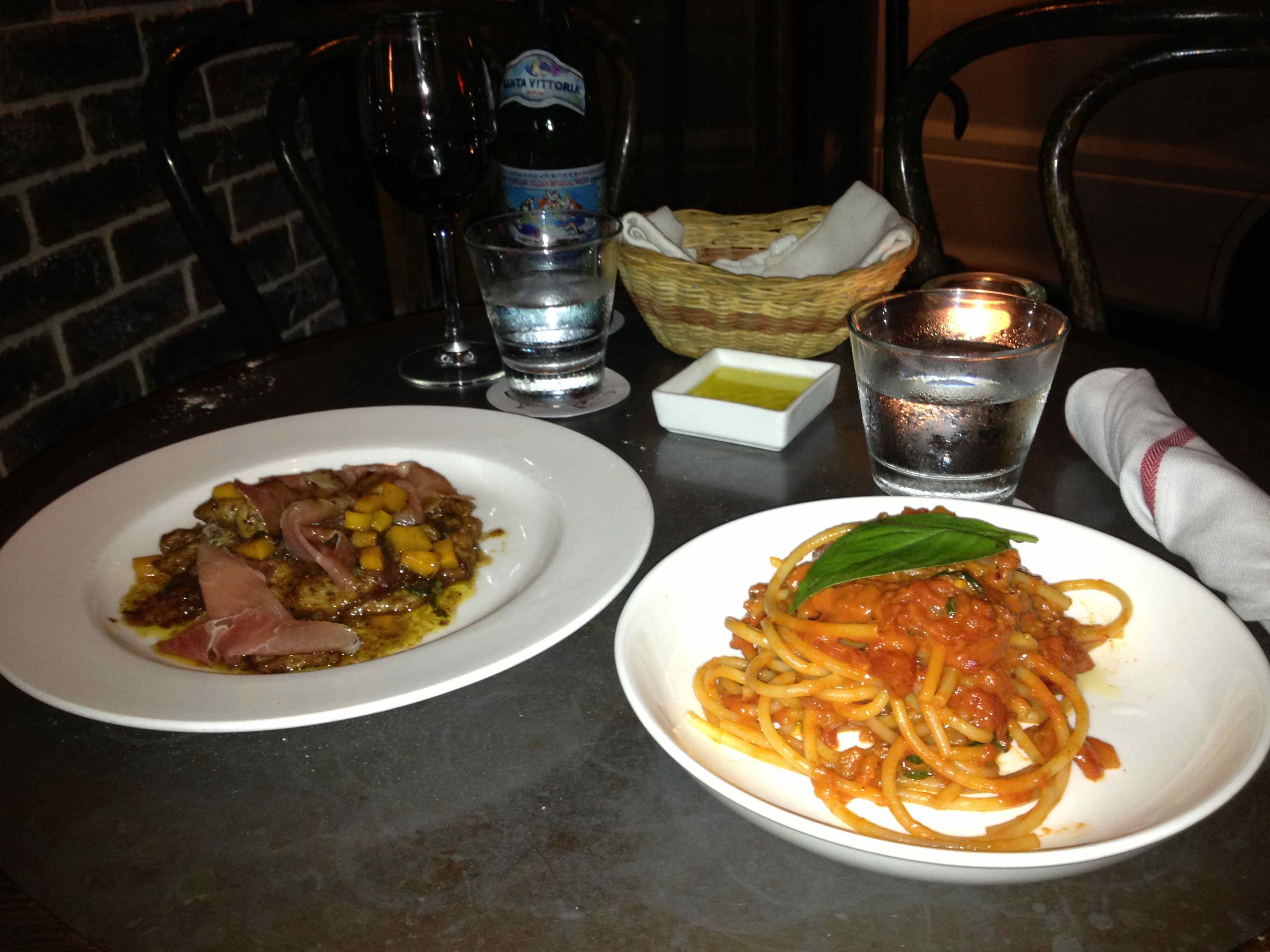
Saltimbocca and bucatini all’amatriciana at Posto Pubblico. Technical problems with WordPress prevent me from uploading more for some reason…

On our last night we managed to go to Hong Kong’s SoHo, a warren of narrow streets winding uphill with loads of hip places to eat, drink and live. We indulged in outdoor dining, which sane people should not do in Guangzhou, at Posto Pubblico, another New York-style Italian place. This one was a vast improvement over our mall experience and S– was happier. A heaping plate of spicy bucatini all’amatriciana with basil and wine-spiked saltimbocca alla romana that favorably compared with my favorite Roman joint in Milano. They brought good bread twice without being asked and I got a good glass of Montepulciano. The waiter was neither unctuous nor over-familiar and as he chased away a beggar dressed as a monk he chuckled to us, “Hong Kong’s biggest scam.” Price: $78. This is why we came here. S– went to freshen up and I sat there in the cool night air listening to the hypnotic house music and thought that with a full bottle I might sit there all night and relive my expat experiences of a decade ago, but that was not to be.

We’ll go back to SoHo to try the Mexican place, the two Argentinian steak places and the three other Italian places. I have faith as they seem geared to those who actually know food, not the desperate, meekly content expats who might think “I don’t care if these nachos are made with orange Doritos that include the toy; this is the only Mexican i’m getting for two years.”

Also worth a visit: the gleaming, ultra-luxe IFC shopping mall along the waterfront. A stop at Singapore-based TWC Tea is an elegant repose after a day of sightseeing, and for about $27, you can pick two teapots from a list of literally hundreds of teas, and enjoy some delicate macarons. For $22 you can take a box of 15 cotton teabags home. Bonus: if you forget that you are in a shiny, steel-and-glass mall, you can pretend you are in 19th-century Europe somewhere.

Our only complaint was the Harbourview, our hotel, which was a bit lacking, especially after our very nice accommodations in Guangzhou. Elevator service was lacking, our view was of a creepy courtyard, and there were few perks — not even free wi-fi. But it was very central, and we didn’t spend much time in it. Here in Guangzhou, we tend to spend more time at home, but that’s mostly thanks to pollution.

The difference between Hong Kong and the mainland is hard to overstate. Most importantly for us, the air is clean-seeming, breathable and it smells like the sea. There was a gentle breeze and generally, it was nice to be outside. During our 48 hours there, it was rainy and cool. No oppressive humidity that orders your brain, trained in the valleys of the Ohio and Po Rivers, to run indoors as quickly as humanly possibly or face certain death by heat stroke, dehydration or exhaustion or all three. No mind-bending pollution. No assault on the senses of every kind of fetid smell you can imagine from organic (rotting pig blood? sewage? stinky tofu?) to chemical (paint thinner? asbestos? vaporizing steel? collapsing village? cocktail of all?). Most everything is orderly in that quintessential English fashion. Everyone, mostly, speaks English. After a few starts, I gave up trying with Mandarin, although I heard a quite a few tourists from the mainland speaking its gong-like, ringing tones. Cantonese sounds less harsh; more tones make it rich and florid. An L.A. transplant of Taiwanese origin I know says it’s the French to Mandarin’s English, although I’m not sure about that.

Hong Kong’s prevailing ethos — the luxury that money buys — has a lot more in common with London or NY or Milan than China, where the ethos is just pure money. Moreover, there’s a general feeling of uprootedness and confusion in China that is hard to capture or describe in a few words. Enormous highways and skyscrapers rise out of nothing. Traffic surges erratically and becomes horrible in second. People walking to work while doing taiji, sometimes even walking backwards. Old ladies cycle against the traffic on huge five-lane highways. People wander along the center lines on these same highways. The empty feeling of massive luxury complexes is highlighted by the huge labor surplus (5-10 people working in one small store, many just standing around). In a gleaming new train station, people sit shoeless on steps amid commuters, eating lunch. A wall breaks away to reveal a construction site, through which workers use forklifts to cart box after box of hundreds of just-hatched chicks, and commuters rush down sparkling new escalators. In short, it can be alien to the newcomer. This feeling was absent in Hong Kong, which I found very familiar despite vast differences in the language and local culture. Chalk one up for the people of the fragrant harbor.


Two Competing Visions

From Per Petterson’s remarkable I Curse the River of Time, two visions of death. He seems to think that the first, and not the second is inevitable, yet he spends considerably more effort describing the second, more pleasant alternative, so which can he hope for?

…when it came to dying, I was scared. Not of being dead, that I could not comprehend, to be nothing was impossible to grasp and therefore really nothing to be scared of, but the dying itself I could comprehend, the very instant when you know that now comes what you have always feared, and you suddenly realise that every chance of being the person you really wanted to be, is gone for ever, and the one you were, is the one those around you will remember. Then that must feel like someone’s strong hands slowly tightening their grip around your neck until you can breath no more, and not at all as when a door is slowly pushed open and bright light comes streaming out from the inside and a woman or a man you have always known and always liked, maybe always loved, leans out and gently takes your hand and leads you into a place of rest, so mild and so fine, from eternity to eternity.

Review of Peter Hessler’s River Town

Fuling, where Peter Hessler served

Peter Hessler was a Peace Corps volunteer in Sichuan in 1996-1998 and his book chronicling his life there, River Town, is an excellent Peace Corps memoir. Even though I can’t think of a place more different from Macedonia, where I served, than China, he still has many of the same or similar experiences living in a remote, rural and developing place. River Town is also highly readable; one can knock it out in a day or two, despite coming in at almost 400 pages. Hessler is a dedicated teacher, even if he is still finding the voice that is so clear in later books like Country Driving: his tendency to mimic repeated Chinese adjectives can annoy, as does his repetition of turns of phrase that he himself admits are awkward and clichéd.  Despite his differences from most of the volunteers I served with — I didn’t know volunteers who went to church, for starters —  the experience is broad enough to resonate with Peace Corps volunteers removed by a decade and thousands of kilometers.

For these reasons, River Town succeeds more as a Peace Corps memoir than as a straight-up China travelogue. Hessler mentions how the one group he connects with the least are the new moneyed young males, arrogant, self-assured, and decked out in garish styles. Macedonia had a similar class — pretty boys with shaved armpits, garish faux-designer sweaters and fast cars, who would eagerly give you a lecture on how much money you could make doing whatever your Peace Corps job was back in America. Like Hessler, none of our group were really friends with this chunk of society. I’m sure large chunks of the rest of the developing world have their analogues as well, even if the stakes may be far higher in ever-growing China.

The book is not without its flaws. Despite being the ultimate Peace Corps book, meticulously chronicling the whole two years of hardships similar to volunteers all over, what I ultimately didn’t like about it was that Hessler’s problems all seemed easily resolved, leaving perhaps some vague sense of discomfort but nothing more.  Largely, his experience is one of positive, self-enriching activities. He rises early to write every day. He diligently masters Chinese without major frustration and speaks exclusively in it. He goes to church and give the church money. He meets crazy desperate women and whores, and nobly turns them down. He participates in macho Chinese drinking, but realizes it is wrong and boring. He cheerfully gets his students through Shakespeare and other English classics, even getting them to perform plays. He is a dedicated runner whose only issue seems to be grappling with American competitiveness.

Too much of this can make the author come across as sanctimonious at times. He tangles with all manner of foreigner-in-a-developing-country issues, but he almost always rationally and calmly makes the right choice, and even when he doesn’t, the consequences are banal: he almost gets into a fight with an ignorant villager, but just walks away after humiliating the guy. I was cheered to see that even the best volunteers almost got into fights with annoying villagers after a year and some of taunts and unwanted attention, but it might’ve been interesting to read about the Peace Corps volunteer who didn’t always make the right choice or who made bad friends.

Although I wasn’t expecting Hessler, who is largely realistic about the goals of his service, to adopt a pro-democracy viewpoint of either the humanitarian interventionist or neoconservative stripe, his judgment did seem off-kilter at least once, less for political reasons than the personal. But the personal is telling: at one point he meets a pro-democracy student whose English name is “Rebecca” and he dismisses him as a loser with a girl’s name, and after giving him an old Newsweek writes the kid off.  After a brief discussion about how this dumpy loser didn’t fit his image of the Tiananmen protesters as “noble characters,” he disappears from the book. Instead, he prefers the nobility of the party:

He was the only student who has anything like a dissident, and I remembered how I had imagined those figures before coming to Fuling. I had always assumed that they were noble characters — charismatic, intelligent, farsighted, brave. Perhaps that was the way it had been in 1989, and perhaps it was still like that in the bigger cities; but here in Fuling things were very different. My best students — Soddy, Linda, Armstrong, Aumur; the ones who were charismatic, intelligent, farsighted, and brave — those were the ones who had been recruited long ago as Party Members. If you had any talent you played by the rules; being a Party Member was good for your career, and in any case all of the students seemed to think that it was good to be patriotic in the narrow way that they were told to be. The image I had once had of the Chinese dissident had no reality in Fuling.

All I had was Rebecca — he was the only one, and he was a loser. He was a bad student, and he was socially awkward. He had no friends. He had a girl’s name. Some of these characteristics had conspired to set him apart, and in his bitterness his ideas had undoubtedly swung even further from the Party line. If there were big changes in China’s future, it was hard to imagine them coming from people like Rebecca, or, for that matter, from any of my other students.

I found the above passage recently reproduced on a blog with a strong nationalistic Chinese bent. (That’s nationalist in the present sense, not the 1949 Taiwan/Guomindang sense.) There are several problems with this, not the least of which is that the authors of such blogs using Hessler’s love of a winner to prop up their own idea that the true and good of China belong to the Communist party and that the marginalized and pathetic are ones who resist it. Of course Hessler spends an equal amount of time talking about how sick he is of the party’s ham-fisted attempts at controlling his school and the teachers’ interactions with students, but that is easily overlooked by the selective blogger.

Hessler does make a good point that being a Peace Corps volunteer makes a foreigner automatically marginal and thus attracts the local fringe element. This is definitely true: certainly Peace Corps volunteers attract both good and bad fringe elements. Sometimes the bad ones were the among worst – several of my colleagues and I had experiences with both categories. But most of the volunteers I knew, who were in-country for complex reasons of their own that might’ve included feeling marginal in their own country, always tried to lend a sympathetic ear to the good fringes. In my own town, my good friends Traki and his pal Ace, sons of a laid-off factory worker and a policeman-cum-hog-farmer respectively, were losers with bad grades who had taught themselves English from action movies. They wanted nothing from me but friendship and gave me just that and more in return.

Hessler’s ardent Chinese Communist Party students remind me of my Macedonian students who had what were called vrski — connections, most of which were with that country’s ex-socialist ruling class as well. They were civilized and the most “European” of my students, speaking usually excellent English well before I arrived, and I liked them — but they didn’t need any help. Mostly their parents had arranged decent careers and jobs for them, and they had little interest in things like scholarships to English-speaking universities and journalism clubs.

The students who were interested were indeed the marginalized — the Roma, the orphaned, the refugees. These were the students that eventually did move, get scholarships for their many talents — languages, computer programming, graphic design — and end up living and earning money abroad. Whether living in the West was ultimately to their benefit is perhaps another question, but I never had any doubt that working on the margins of the world I would end up serving the marginalized.

Some Jon Cook Music

Jon Cook & Tony Bailey playing together; Crain @ the Cherokee 1995

I didn’t make it to Louisville in time for Jon Cook’s memorial on March 9th, but I was in Louisville recently and I did extract some Jon Cook gems from my archives. The first two feature Jon’s collaborations with a couple of other recently- and tragically- departed Louisville musicians.

“Unhindered Perception of the Happy Machine”

For some reason I always liked this song a lot, even if the lyrics are barely intelligible and the song meanders along. Never recorded in a studio, this is from a show in Chicago in the mid-90s, featuring versatile drummer Tony Bailey, who also left the earth far too early in 2009. Listen to how the song verges on falling apart near the end, but Tony manages to bring it back together. Critics usually call Crain “math-rock” which implies an incredible level of tightness. I don’t dispute that Crain went through a period like that, but a lot of late Crain seemed fairly loose, held together by solid musicianship and that elusive intuition that all musicians seem to chase.

“Broken Heart of a Neutron Star”

Live at a 1994 Simple Machine gala emceed by Jason Noble, who also died last year tragically young. Not really my favorite take of this tune, mainly since Jon Cook doesn’t sing it and it’s his song, but this version is notable mainly for Jason Noble’s hyperactive and hyper-enthusiastic introduction. Louisville is indeed a muddy horse farm as well as something of sprawling metropolis, at least if you are from elsewhere in Kentuckiana. The rumor in 1994 was that the original title of the song was “Noble Attitude” and that Cook had written it about his friend.

“Double-Cross Pollination”

Not a Crain tune, but an Experimental Pollen tune. Experimental Pollen was a ferocious live band that featured Troy Cox from Evergreen on bass and engineer Will Hancock from 456 on drums. They played the party circuit ca. 1996-1997 and were most noted for headlining a New Year’s party at the Lausman’s family farmhouse on the outskirts of Louisville. An all-star AC/DC cover band featuring Cook, Britt Walford and Crain alumnus (and musician in his own right) Jason Hayden warmed the crowd up. This being New Year’s in Louisville, we didn’t need much warming up. Pollen took the ‘stage’ which was a hardwood floor, in front of several hundred sweaty, intoxicated kids with great anticipation around midnight. Will counted off, 1-2-3-4, and the crowd reared up, ready to jump as one to the sound of the rock. The first note rang out, the crowd all hit the floor at the same time, and there resonated a horrendous and violent creak — the sound of the floor giving way. The music abruptly stopped, the whole ugly engine of the bass and drums grinding to a halt. Cook sheepishly spoke into the mic: “Uh. I think we broke the floor.” One of the elder Lausman brothers ran downstairs, perfunctorily checked the foundations, and came back upstairs, giving the all-clear sign, and the rock commenced into 1997.

This song doesn’t have that raw energy but is a bit more subdued, which was another side of Cook’s songwriting. Experimental Pollen released a 7″ with guest appearances from noted producer indie rocker Flood, which is pretty worth hearing (if memory serves) and also a split LP with Louisville heavies Wino. The split LP is worth hearing for the Wino songs; let’s leave the review at that.

Coming soon, I hope: a live 1992 recording of Crain doing the Misfits’ “Teenagers from Mars,” as well as more live material. Watch this space.


On the Unremarkable Processes of Life

I had a relatively minor surgery last week and thus had more than the usual amount of time to sit around reading, especially about healthcare, medicine, and most of all its incredible rising cost.

From Craig Bowron’s most recent article in the Washington Post comes an excellent meditation on dying in the 21st century, on par with Atul Gawande’s work in the New Yorker.

For most of us living with sidewalks and street lamps, death has become a rarely witnessed, foreign event. The most up-close death my urban-raised children have experienced is the occasional walleye being reeled toward doom on a family fishing trip or a neighborhood squirrel sentenced to death-by-Firestone. The chicken most people eat comes in plastic wrap, not at the end of a swinging cleaver. The farmers I take care of aren’t in any more of a hurry to die than my city-dwelling patients, but when death comes, they are familiar with it. They’ve seen it, smelled it, had it under their fingernails. A dying cow is not the same as a person nearing death, but living off the land strengthens one’s understanding that all living things eventually die.

Somehow the quote ties together a number of disparate threads on life and death in the media recently, from Teju Cole’s comment that drone strikes have given us an empathy gap to the death of a young woman in a lion cage this week and the salt-of-the-earth farmers in John William’s brilliant Stoner (who should get credit for the title).

Bowron has another excellent piece from 2009 online here.

Goodbye, Jon Cook

You can’t revisit your childhood, because it no longer exists, I told myself.

Thomas Bernhard, Extinction

Jon Cook from Crain and Rodan, two of my favorite homegrown bands, was finally taken off life support tonight, ending two days of tortuous rumors and speculation. He was a bright spot in Louisville’s underground in the ’90s, which makes his senseless death sadder still. I guess he had been going through a long decay for most of the last decade, maybe longer: drugs, alcohol, dereliction.

Crain’s music was huge; sometimes angry, sometimes delicate, not unlike the people who made it. But more than the music, Jon was a rallying point, someone who repeatedly left our little provincial burg to travel the country in a van, bringing treasure and glory (well, not much treasure — it was rock ‘n’ roll, after all) back to us.

I remember running into him at an all-ages club one cold night in fall 1992. He and Crain had just gotten back from Albini’s studio in Chicago, where they’d recorded songs for a new EP. He was energetic; manic, almost, but who wouldn’t be? Steve Albini was a legend to anyone who played non-commercial pop music in the ’90s; the fact that a kid in a band could just drive up to his studio and record was special, particularly from a teenager’s viewpoint. People like Jon fulfilled that basic need to feel part of something bigger, important to a frustrated adolescent.

Jon was a friendly and kind man. Bands wanted to come to Louisville because in the ’90s he brought every touring act on the indie circuit — from Fugazi to the Jesus Lizard, from the Riot Grrl! bands to the Rollins Band, from Sleepyhead to Hammerhead — to Louisville and let them stay in his mom’s house, where she’d make them hearty spaghetti dinners.

Later, the old Victorian mansion he owned called the Rocket House became a sort of creative crash pad. There was always a band playing there, or maybe staying there while on tour, and the walls were festooned with the numbers and names of virtually everyone in the ’90s underground — Ian McKaye, Kathleen Hanna, Jenny Toomey, Corey Rusk — written in magic marker. If you stopped in, you might see Jeff Mueller making a sculpture out of junk, or you could hand Bob Weston your joke band’s demo, or you might end up as the extra in an indie movie, or you could hang out with older, perhaps not-always-wiser people.

But what I didn’t think of as a teenager was that Jon Cook had a Victorian mansion at age 21 because his own dad had passed away, I think, in a house fire started by a cigarette. I met his mom, Peggy, on several occasions. She was nice, too, and I thought it was funny that a woman my mother’s age would pour me such stiff gin and tonics. Maybe there’s something to be learned there that I still don’t know.

Back in the ’90s, I heard he was supposed to take meds but didn’t. I heard a lot of stuff.  I heard he wrote a novel. He definitely drew cartoons. He kept making music. Once, I walked into a bar and saw him play on guitar, unaccompanied, a song written by a friend of mine that I didn’t think anyone else knew very well. He played it beautifully, and then indie legend Lou Barlow got on stage and played. And then Jon was nowhere to be seen. The last time I saw Jon was in summer 2010 and he seemed friendly — too-friendly; unbalanced. I got spooked, and I took off.

We have an idea that someday, we can go home and things will be a little bit like they were when we left. But the people that defined my home keep leaving for good. Tony Bailey, Jason Noble, now Jon Cook — these people who were larger than life once keep leaving life behind. What they leave behind is a gaping void.

Goodbye, Jon. Rest in the peace that seemed so hard for you to find, and rest knowing that for the brief period you were on this planet, it was a better place.


Zombie Rock and the Duke of Hazard

What’s going on with hipster music? It’s an interesting question. About ten years ago I wanted to write a piece for my local weekly, Baltimore City Paper, on how the fuzzed-out, overdriven indie rock of my youth, largely springing from the AmRep and Touch & Go labels, had been replaced by another genre with the same name but sporting not only a totally different style of music, but seemingly a different ethos towards life. They never bought my pitch and I moved on to other things for most of a decade.  In that decade, it seems like rebellion turned into reflection which turned into introspection which just devolved wholesale into whining.

This week we’re got the LA Weekly treating us to a pretty snarky, if not accurate, takedown of the 20 most annoying hipster bands. I take some issue with putting TV on the Radio, who treated me to a phenomenally energetic and sweaty set in London in 2004, on the list, but for the bands on the list I’ve heard, it’s spot-on. Beirut has the sound of a precious kid who just discovered world music, pilfering from the Balkans and the Middle East equally blithely. The Decembrists play the same sort of bland pop that was just taking over a decade ago. As for Black Keys, remember Jon Spencer Blues Explosion? People accused him of stealing from the black musical tradition (a silly premise, given how most of what’s good about American music comes from free-flowing musical miscegenation), but at least he smashed things and “fucked shit up.” Most of the music in the LA Weekly piece is more about image and solipsistic preening than the raw emotional release that blues, rock and punk are famous for. It’s a funny piece, but there is some anger in the last write-up, a takedown of Bon Iver:

What happened to us as a generation that this guy gets to bear our sonic torch? Those who came before us rocked, bumped and grinded. They exuded raw sexuality and riotous anger; sweaty human realism. They hoovered drugs or angrily rejected them, they humped strangers in club bathrooms in adolescent indiscretion; they broke shit, laughed, cried, partied on rooftops or in warehouses, exercised cultural demons and personal failures, made spectacles. We, instead, get a whiny guy who built his own studio in the woods; perfectly exemplifying that narcissistic hipster ethos of “Whatever man, I’m just gonna go over here and be chill, I don’t want to be bothered or have my mellow harshed.” Bon Iver coos the celebratory ballads of hip poseurs who refuse to get their hands dirty, that is, unless that filth is quaint and photogenic.

Well said.

There are a couple of different issues going on with rock music lately — Sasha Frere-Jones is particularly trenchant in his examination of the lack of miscegenation in a New Yorker piece from a few years back. He also points out that “pop music is no longer made of just a few musical traditions; it’s a profusion of strands, most of which don’t intersect, except, perhaps, when listeners click ‘shuffle’ on their iPods.”

For this reason, Michael Jackson was the last pop star in the way that Kurt Cobain was the last rock star — there are so many subgenres and subsets now with the new media that it seems like it might be hard to have that one unifying figure. More to the point with punk and guitar music, one can see some kind of clear line between the fifties rebels, the hippies, the punks, and grunge/aggressive nineties loud guitar music. “Wild Thing” played really loud is a pretty great anthem no matter what decade you’re in, if you’re into guitar sounds. Black Flag covered “Louie Louie” as a sort of goofily, violently frustrated punk anthem in the eighties, and  the glorious Laughing Hyenas covered “I Want You” by the Troggs regularly — reclaiming heart-on-the-sleeve anger for the grunge generation from the MC5’s revolutionary fervor. A lot of the early punk sounds a lot more ’50s than ’60s. There was continuity.

Many of the bands slammed in the LA Weekly‘s piece emphasize style over substance, image over guts and cuteness over beauty. (Watch Nataly Dawn’s precious annoucement to her fans if you don’t believe me.) Even in deep in the underground this has been true for most of the last decade. For example, in my erstwhile home of Baltimore, bands were always high on the theatrics but there was also a core of good rock songwriting underneath — Buttsteak and Lee Harvey Keitel Band took pleasure in outlandish names and bountiful literary and philosophical references, but they were good musicians and songwriters, too. A bit later, Oxes dominated the Baltimore scene. They wrote instrumental math rock, played wireless, and their schtick was to run around the audience mugging. Seen once, it seemed to push boundaries — but seen more than that, it seemed like self-conscious schtick. Later still, Dan Deacon got huge with his whole Wham City collective, basing his style on audience participation and performance with laptop electronica songs.

Rock and roll’s death has been proclaimed many times, and each time it proves its resilience. Lately maybe it’s a bit zombified, to borrow from another hipster trope, by navel-gazing one-man shows backing themselves up. But some good can come of all this: one of more intriguing acts I’ve heard lately is Adam Brewer from Hazard, Kentucky who follows in the great tradition of other Appalachian hollerers such as Hasil Atkins. But this isn’t backwoods psychobilly — it’s raw rock and roll.  It seems like no one else in Hazard was interested in playing live with him, so his shows are him singing to a backing tape of his band, of which he is the only member, the Globsters. Some is abrasive noise in the mold of Slap-a-Ham records, but much of it actually displays a refreshing honesty laid over genuine melody; a shiny penny of a song emerging from a zombie-grave dirtclod.

Check out “Pretty Women” (“pretty women, rockin’ and rollin’, gimme a beer, I’m high as a kite”), “Freddy Krueger” (“I’m not afraid of Freddie Krueger, I am absolutely horrified by you/you’re the one/you’re the one that keeps me up all night”) and “Roll You Up and Smoke You” (“you’re so cute/I just wanna roll you up and smoke you/ we were sitting on the couch/listening to records/I just wanna pass a bowl and smoke it with my baby girl”) are honest youth anthems of rebellion, love and angst. Perhaps there is some hope for rock and roll after all.

Check the mini-documentary from august punk bible Maximum Rock ‘n’ Roll.

Thanks to Johnny Cuba for the inspiration.

Goodbye, Jason Noble

I knew Jason Noble was sick about two years ago, and I knew it was a nasty cancer, and I knew he’d beaten it for the moment. I didn’t know he was sick again so I was surprised this morning when a fellow refugee from Louisville told me that he’d passed. Jason, along with his musical cohorts at the Rocket House and at ear X-tacy made being a teen in a city where open-mindedness did not come easily a lot more palatable.

It’s rare in the narcissistic, instant gratification-fueled world of 21st-century communications that a person with a public persona passes and is genuinely mourned. To a geeky, bored, often angry kid seeking any kind of interaction beyond teachers and churches, Jason was a kind, gentle and open soul. His art — from post-rock epics to simple sketches — made perfect sense to those who grew up in the same fishbowl. He clarified the distortions and gave voice to the frustrations.

RIP, Jason Noble. As a writer greater than this scribbler once said, his spirit shines through him.