I’m not entirely sure what to say about this at the Banco di Sardegna near Corso Sempione, but I walk by it every night and it seems like the most peculiar deterrence to me: positioned inside the entryway to the bank, behind the barred gate that’s pulled down every night. Just inside is a video monitor. On it, more or less continuously (also during the day), an image of one or two security guards watching a video screen plays.
What they’re watching is you as you approach the bank, and this is shown to you. If you stick your hand through the bars (as I did to take a picture), an automated voice warns you (as if you didn’t already know) that the bank is under surveillance. I half expected the guards to come chasing me out of the bank and onto the street, as might happen in Belgrade or Washington, but no. I fully expected to see myself on the screen, much like when Laura Palmer opens her bedroom door in Fire Walk with Me and sees herself entering a painting on her wall.
I’m not going to even pretend that this will be easily comprehenisble to those without a command of both what’s going with Berlusconi these days and the Italian language, although the Corriere‘s English language edition — serviceable but nothing compared to examples like Germany’s Der Spiegel — can elucidate here.
Benigni once again proves he’s one of Italy’s top satirists, taking the PM down on a variety of levels. If it just seems silly, then at least skip ahead to 3.23 where he starts dancing around.
Not a lot makes me miss DC. But these Fugazi videos did, even though they’re not shot in the District. Even those who might find the band overly serious or self-righteous still should appreciate the incredible energy of the band and of Guy Picciotto in particular. He calmed down from putting himself through basketball hoops as the band matured, but check out his footwork and clapping on this decade-old video of “Margin Walker” and “Waiting Room.” (You understand Picciotto’s original role as a ‘toaster’ in the second. No less thrilling.)
For proof that that energy could be felt by the audience — even an aging one — check out the white-shirted fan, delirious with the power of rock and roll, in this video from my hometown. I wish I could say I knew him. I’m at least glad the YouTube universe, often so catty, was as thrilled by him as I was.
It’s been awhile and no updates. Yet, in the US we’ve had the midterms, which happened pretty much as predicted, and here in Italy Berlusconi again dominates the headlines with another sex scandal. At this point I’m so fatigued by his scandals that I’m withholding comment until I figure out just how much of a survivor he is. Needless to say it’s hard for me to imagine a gulf of power any greater than that between the Prime Minister of a G7 nation and an undocumented 17-year old immigrant. It remaines whether Italians will let this distract them from the many economic and domestic crises that threaten the bel paese or whether this will galvanize them into action. Of course my weariness is probably not atypical. American writers often assume that the next scandal will be the last straw — wouldn’t it be at home? — but only a few seem to understand the lack of clear alternatives and the cynicism that has permeated Italian politics for the last twenty years. British writers, however, often do. The Telegraph has all you really need to know to understand the events of the last week. And if reading an Anglo-Saxon male writing about the Italian politics seems odd to you, then the Guardian weighs in as well with the powerful voice of Maria Laura Rodotàof the Corriere.
As a side note, I’m thrilled to hear that the unctuous Lele Mora is under investigation. No one who has seen the scenes in Videocracy in which Mora, puffy and dressed all in white, in an all-white room in an all-white house, celebrates Mussolini with a fascist cellphone ringtone and introduces his young musclebound brainless tronisti proteges, would disagree.
Of course, as a longtime Italian-observing friend of mine quipped, if Berlusca had sprung for the quick release of a Moroccan man from jail, then his popularity might really flag. But the PM is hasty to admit that hey, at least he didn’t do that. His exhortation that loving “pretty girls [is] better than being gay!” got the headlines and got people out to protest as well. And produced a spew of plays on words: “better gay than Berlusconi,” “better gay than fake daddy” (playing on the nickname that the previous sex scandalizer Noemi had for the PM).
On the upside for happenings meneghine, I was pleased to see on a recent walk down via Manzoni that La Scala is doing Lulu this season. Now how can I get to it?
And in happenings Venete… wear your rainboots, avoid back roads, and keep your livestock on high ground. Rural areas experienced terrible flooding this week, not as far south as Rovigo, but around Padova and Vincenza. Bertolaso, seeming to be in both Naples and the Veneto at the same time, is on the scene.
For all their carping on about the lofty ideals of 18th-century Americans, the Tea Partiers — at least Rand Paul’s — sure don’t abide by one: chivalry. Really, now, stomping on a female’s upper body and then having the gall to ask for an apology? Are we really that divided?
Doing some research on Milosevic cheerleaders and Srebrenica deniers Living Marxism, I happened upon this debate in the 8 July 1993 issue of the London Review of Books. If you’ve been following the discussion on my post on Mladic you might’ve heard the assertion that the only way to reverse the gains made by the ethnic cleansing that Bosnian Serbs mainly accomplished in two shorts weeks in the spring of 1992 would have been a total military defeat. This is true, but the time for this was, of course, in August 1995 and not the present. But the following quote from author Mark Thompson practically could’ve have come from these pages:
Nothing but nothing will ‘reverse ethnic cleansing’ (David Owen’s initial aim) except a military defeat inflicted upon Serb forces in Bosnia-Herzegovina (and David Owen was employed, of course, exactly to try and forestall the necessity of Western military action by persuading the Serb forces to abandon their maximal aims). Without a Serb defeat there is no chance of stability for the entire region, no hope for Bosnia Herzegovina, and only black prospects for Serbia and Croatia.
Of course not all of this is true. Serbia and Croatia’s prospects are not ‘black’ at present; Croatia’s haven’t been for quite some time. And David Owen might’ve indeed had the lofty aim of reversing the ethnic cleansing that went on in the first draft of his plan, but he and Cyrus Vance eventually had to own up to the reality on the ground, which was sharply slanted in the Serbs’ favor. That reality was reflected in their second plan, which was enormously unpopular in that it would’ve only solidified Serb gains. Of course it was rejected by Bosnian Serb leadership, who at that point must’ve been feeling pretty invulnerable.
It’s hard to reverse territorial gains (and the terror campaigns that inevitably go with them) without an army. No one learned this lesson more bitterly than the Croats and Bosnians in this conflict. The only “plan” that would have had any success was the Carrington-Cutileiro one — because it was designed to prevent, not stop, fighting. But it was too little, too late.
NB: Those who read this letters column to the end will find a young Marko Hoare going the distance over wartime nationalism in the Nazi-occupied territory of Serbia and Croatia.
And so we have… the Tea Party in the Commonwealth of Kentucky.
I do find MoveOn imminently annoying. But there’s no excuse for such thuggery. Not even Conway’s fairly low-blow striking ad. It doesn’t exactly bode well for free expression, especially when coupled with Rand Paul’s extremist beliefs in virtually every other area. Let’s help this will help ruin him. If he wins after this and the Maddow debacle, it will say something about Kentucky. A very negative something, along the lines of “what a bunch of hicks.”
To conclude all this southeastern Europe-focused posting on a positive note, I strongly urge all fans of energetic guitar-based music to check out Belgrade’s excellent Stuttgart Online and to buy their infectious album Radost Svakom Domaćinstvu. They definitely capture the dada-street art sound of late seventies Belgrade as immortalized on the anthology Paket Aranzman — particularly the bottom end-heavy sound of Sarlo Akrobat.
There’s not much in English, but here’s a note from Exit Festival 2010, Novi Sad’s annual music festival. But who needs English? It’s music. Take a listen to “Superheroj” right here on YouTube.
Fans of energetic guitar-based music take note: this band has no guitarist.
Thanks to Igor for the recommendation.
Blog will return to south-central European-focused affairs momentarily.
The Dutch held out but Europe, as usual, wants to have its way so after a threat to ram Serbia’s EU ‘assessment’ through by majority vote, the Dutch folded. However, there is a provision that every step of Serbia’s accession will have to be subject to a unanimous vote. The Dutch, we can imagine, will watch that closely.
It’s hard to know what to say at this early hour, although I’d caution Westerners to pin all hopes on Serbia. Much analysis has mentioned that Serbia, as the largest and most populous ex-YU state, is the linchpin of the Balkans. Well, Greece seemed to be the most well-off until recently, and it has hardly assumed a leadership role in the region. Tadic’s government has done much, esp. in defreezing the lock over Kosovo, but remember that there are blocs — substantial ones — of extremely regressive bodies politic in Serbia that could come to power. Would Serbia continue to enjoy this prestige of leadership if so? The lesson is not to conflate territory and population with leadership.
And while I’m at it I’d like to point out the folly of articles likethese. (The latter being far more reputable than the former.) Saudi and Iranian money in Bosnia and other Muslim parts of the Balkans (like Macedonia, which the Greek author of the International Analyst Network piece desperately tries to avoid mentioning) is nothing new and dates back to the arms embargo in the 1990s in Bosnia. Every few years, a journalist sees a pre-fab concrete mega-mosque and wonders if the often-propagated tale that Osama is using these Muslims to try and get ‘into’ Europe is true. It’s not. In the mid-1990s, there was an attempt to radicalize Bosnian Muslims. They rejected Wahhabism and its severe tenants. A 40% unemployment rate, or even an 80% one, won’t change that. To pretend otherwise is to toe a chauvinist line.
It’s turning out to be a Bosnia-focused weekend here.
Marko Hoare has an excellent and sober assessment of Angelina Jolie’s Bosnia “imbroglio” up here.
For those who don’t know, the British left often has an odd — to say the least — way of viewing the Balkan Wars. Mainly it consists of lionizing Milosevic as some kind of “anti-imperialist” simply because he was able to get his country bombed by NATO. This is an old article from Indymedia Ireland that explores some of the myths and flat-out denying that go on amongst some British leftists when they discuss the Balkans. It should serve as a useful warning for a treacherous path to “sinister idiocy” that sadly continues to influence thinking on the region.
Finally, it seems that Greek nationalists have managed to clean the internet of any photos of their paramilitary unit, the Greek Volunteer Guards, with Karadzic and the Bosnian Serb leadership. But fear not, Takis Mikas’ intriguing book Unholy Alliance is up on Google Books. The above photo is from it. It’s worth pointing out he’s being sued for for stating that the Greeks were in Srebrenica, and it’s further worth pointing out what the name of the organization that’s suing him is. And here’s Hoare on the same issue.
 I’m not entirely sure what to say about this at the Banco di Sardegna near Corso Sempione, but I walk by it every night and it seems like the most peculiar deterrence to me: positioned inside the entryway to the bank, behind the barred gate that’s pulled down every night. Just inside is a video monitor. On it, more or less continuously (also during the day), an image of one or two security guards watching a video screen plays.
 What they’re watching is you as you approach the bank, and this is shown to you. If you stick your hand through the bars (as I did to take a picture), an automated voice warns you (as if you didn’t already know) that the bank is under surveillance. I half expected the guards to come chasing me out of the bank and onto the street, as might happen in Belgrade or Washington, but no. I fully expected to see myself on the screen, much like when Laura Palmer opens her bedroom door in Fire Walk with Me and sees herself entering a painting on her wall.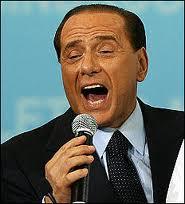
 For all their carping on about the lofty ideals of 18th-century Americans, the Tea Partiers — at least Rand Paul’s — sure don’t abide by one: chivalry. Really, now, stomping on a female’s upper body and then

